Laika – The story of a Soviet space oddity
Laika: The First Dog in Space
In the mid-twentieth century, the world was locked in a fierce race to conquer a new, uncharted frontier: outer space. On November 3, 1957, the Soviet Union stunned the globe with the successful launch of Sputnik 2. But the lone cosmonaut aboard this historic satellite had no concept of the Cold War, the space race, or the profound significance of her flight. She was Laika, a humble mixed-breed street dog, and she was about to become one of the first living creatures to ever orbit the Earth. Tragically, her groundbreaking first voyage was always destined to be her last.
From the Streets of Moscow to the Stars
Before she became an international icon, Laika was just a three-year-old stray trying to survive the bitter winters on the streets of Moscow. Researchers believed she was a Husky or Spitz mix, likely with some Terrier lineage. To the Soviet scientists and personnel who worked closely with her, she was affectionately known by several endearing nicknames, including Kudryavka (Little Curly), Zhuchka (Little Bug), and Limonchik (Little Lemon).
The Perfect Candidate
The Soviet space program specifically sought out stray dogs for these early, dangerous missions. Scientists theorized that a dog who had already learned to endure extreme cold, hunger, and the harsh conditions of street life would be biologically and mentally better equipped to handle the intense stress of spaceflight.
Laika ultimately stood out from the pack and was selected for three primary reasons:
-
Resilience: Her life as a stray proved she was incredibly tough and adaptable.
-
Size: She was small and compact, making her the perfect fit for the heavily restricted, cramped cabin of the Sputnik 2 satellite.
-
Temperament: Despite her rough beginnings on the streets, Laika was exceptionally docile, patient, and friendly toward both humans and other dogs.
A Grueling Preparation
Laika, along with two other canine candidates named Albina and Mushka, was subjected to a rigorous and exhausting training program to prepare for the monumental launch. The preparation was strictly designed to mimic the intense physical and psychological conditions of spaceflight:
-
Extreme Confinement: To acclimate the dogs to the tiny, restrictive cabin of the satellite, they were kept in a series of progressively smaller cages for up to 20 days at a time.
-
Launch Simulation: The dogs were regularly placed in fast-spinning centrifuges to simulate the massive G-forces of a rocket launch. They were also placed in specialized machines that blasted the deafening, vibrating noises of a spacecraft engine.
-
Space Rations: Because a traditional diet would be impossible in zero gravity, the dogs were trained to consume a high-nutrition, gelatinous paste that would serve as their only food and water source in orbit.
Through it all, Laika’s calm and gentle nature endured, cementing her place not just in the history books, but in the hearts of the scientists who prepared her for her one-way journey into the stars.
The Chosen Cosmonaut
As the launch date drew nearer, Laika was officially selected as the primary “flight dog” for the orbital mission. Albina was designated as her backup, while Mushka served as the ground-control dog for continued testing.
Everyone involved in the project knew the heartbreaking reality: Sputnik 2 was hastily built and not designed for a safe re-entry. Laika’s historic first voyage would also be her last. Aware of her grim fate, lead scientist Dr. Vladimir Yazdovsky took Laika home shortly before the launch so she could play with his children. “Laika was quiet and charming,” he later recalled. “I wanted to do something nice for her: She had so little time left to live.”
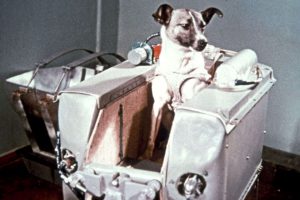
On October 31, 1957, Laika was placed inside the tiny capsule. She was carefully groomed, and technicians attached vital sensors to her body to monitor her heart and breathing. Just before sealing the heavy hatch, the technicians gently kissed the little dog’s nose, bidding a final farewell to the brave pioneer they knew they would never see again.
The Launch into the Unknown
Sputnik 2 blasted into the sky on November 3, 1957. Telemetry sensors beamed data back to Earth, confirming that Laika had survived the intense G-forces of the launch. Though her vital signs showed she was terrified and highly agitated, she eventually managed to calm down as the capsule entered zero gravity, and she was even recorded eating her specially prepared food.
Tragically, this brief period of calm did not last. Just five to seven hours into the voyage, all signs of life from the spacecraft ceased. Laika had passed away.
The Tragic Truth
For decades, the Soviet Union obscured the real cause of Laika’s death. The official story claimed that she had survived for several days and passed away peacefully, either from oxygen depletion or from a pre-poisoned food ration intended to give her a painless death.
It wasn’t until 2002 that the Institute for Biological Problems in Moscow finally revealed the harsh truth. Due to a malfunction in the spacecraft’s rushed thermal control system, the cabin’s temperature had soared dangerously high. Laika had actually succumbed to severe heat exhaustion and immense stress by the time the satellite completed its fourth orbit around the Earth.
A Legacy of Compassion and Change
Though Laika’s fate was undeniably tragic, her sacrifice ignited a global conversation. The revelation that she was never meant to survive sparked immediate, worldwide outrage regarding the ethical treatment of animals in scientific research. Even prior to the launch, organizations like the RSPCA were flooded with protest calls, and impassioned animal rights demonstrations were held outside the United Nations in New York City.
Because of this intense outcry, future space missions were strictly redesigned to ensure the safe recovery and return of animal passengers, which ultimately paved the way for safe human spaceflight.
Decades later, Oleg Gazenko, one of the lead Soviet scientists on the Sputnik 2 project, publicly expressed profound remorse for his role in her fate. “Work with animals is a source of suffering to all of us,” he stated. “We shouldn’t have done it… We did not learn enough from this mission to justify the death of the dog.”
Honoring a Hero
Today, the little street dog from Moscow is immortalized as a global icon. A statue of Laika stands proudly at Star City, Russia’s cosmonaut training facility, alongside a plaque commemorating fallen space pioneers. She is also prominently featured on the towering Monument to the Conquerors of Space in Moscow. Most fittingly, at the military research facility where she was originally trained, a dedicated bronze monument depicts the brave, gentle Laika standing atop a space rocket—forever reaching for the stars.