History of the Rottweiler
The Rottweiler: Beyond the Guard Dog Stereotype
Big, muscular, and imposing, yet remarkably calm and steadfast. To the uninitiated, the Rottweiler looks like the quintessential junkyard guard dog—one that should be sitting behind a fence wearing a spiked collar and barking at passersby. However, this magnificent breed is vastly misunderstood. While they certainly make formidable protectors, the true Rottweiler is incredibly versatile, deeply loyal, and possesses a rich, fascinating history.
From Roman Legions to the Butcher’s Cart
The Rottweiler’s deepest roots trace back to the Roman Empire. Their ancestor was the ancient Molossus, a massive, mastiff-type dog used by Roman legions to herd and guard the cattle that sustained the army as they marched across Europe.
Centuries later, descendants of these Roman dogs settled in the southern German town of das Rote Wil (later known as Rottweil) in the region of Württemberg. Here, they became known as the Rottweiler Metzgerhund (the Butcher’s Dog of Rottweil). They were the ultimate multi-purpose working dogs: herding cattle into town, guarding property, and pulling heavy wooden carts loaded to the brim with butchered meat. The local butchers trusted these dogs so implicitly that on the journey home from the market, they would often tie their heavy leather purses—full of the day’s gold and coin earnings—securely around their dogs’ incredibly thick necks to keep them safe from highway robbers.
By the mid-19th century, the Industrial Revolution and the expansion of the railway system nearly spelled the end for the breed. With cattle now being transported quickly by train, the Rottweiler was suddenly out of a job, and their numbers plummeted dangerously low.
The 20th Century Revival
Fortunately, the late 19th and early 20th centuries sparked a renewed, organized interest in European dog breeding. In 1901, the first official Rottweiler breed standard was established. Breeders quickly realized that the Rottweiler’s immense strength, high intelligence, and fearless loyalty made them the perfect candidates for police and military work.
They were introduced to the United States in the 1920s, and the American Kennel Club (AKC) registered its first Rottweiler in 1931. Following World War II, their popularity soared globally as people discovered their exceptional trainability and capacity for high-level obedience and protection sports.
Appearance: The Canine Bodybuilder
Think of the Rottweiler as the canine equivalent of a heavyweight bodybuilder. They are massive, deep-chested, and heavily muscled, exuding raw power and endurance.
-
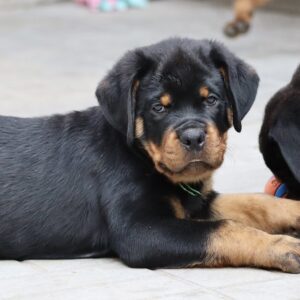
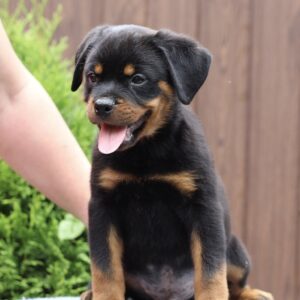
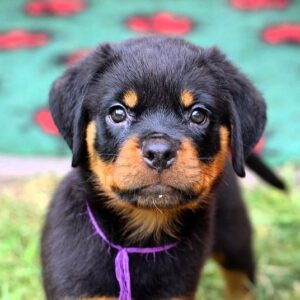
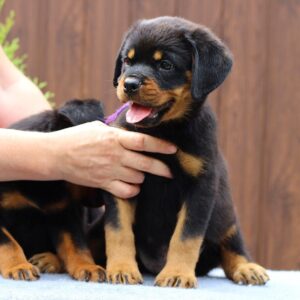
The Coat: They sport a short, dense, and low-maintenance black coat, highlighted by distinct, rich rust or mahogany markings on their cheeks, muzzle, chest, and legs.
-
The Face: They have a broad, blocky head with warm, dark brown eyes. (While blue eyes occasionally appear due to genetic anomalies, they are considered a major fault in the breed standard).
-
The Tail: Traditionally, their tails were docked short to prevent injury while pulling carts. However, this practice is now illegal in many countries, so it is increasingly common to see Rottweilers sporting their natural, thick, and surprisingly long tails.
Temperament: The Confident Guardian
A well-bred Rottweiler is calm, self-assured, and brave. They have a “wait-and-see” attitude, meaning they are often stoic and observant—rather than aggressively reactive—when evaluating new people or situations.
-
Family Dynamics: With their families, they are incredibly affectionate and even downright goofy. They are famous for the “Rottie Lean,” where they press their heavy bodies against their owner’s legs as a sign of love. If raised with children, they make fiercely devoted family dogs, though their ancient herding instincts may cause them to try and “bump” small children to herd them.
-
Exercise Needs: This is a working breed that requires substantial daily exercise to prevent boredom and destructive behavior. Several long walks, coupled with rigorous playtime, are essential.
-
Mental Stimulation: Because they are highly intelligent, they thrive on mental challenges. They excel in advanced obedience, agility, tracking, and scent work.
-
Socialization is Mandatory: Even the best-tempered Rottweiler has natural guarding instincts. You must begin socializing your pup from day one. Exposing them to a wide variety of strangers, animals, and environments teaches them to differentiate between normal daily life and a true threat.
The Importance of Responsible Breeding
Unfortunately, the Rottweiler’s reputation has occasionally been tarnished by reports of aggressive behavior. This is almost entirely the result of puppy mills, backyard breeders, and irresponsible owners who fail to train their dogs properly. When dogs are bred for aggression or “sharpness” rather than a stable, calm temperament, it creates a dangerous liability.
If you are looking to bring a Rottweiler into your life, it is imperative that you source your puppy from a highly responsible, ethical breeder who breeds exclusively for a sound mind and robust health.
Health and Wellness
Like many large and giant breeds, Rottweilers are predisposed to certain hereditary health issues:
-
Joint Dysplasia: Hip and elbow dysplasia are common. Because Rottweilers love to eat and put on weight easily, keeping them lean is critical. Obesity puts severe, unnecessary stress on their joints and dramatically increases the risk of dysplasia.
-
Cruciate Ligament Tears: They are prone to tearing their Anterior Cruciate Ligament (ACL/CCL) in their hind knees, which often requires expensive surgery.
-
Eye Conditions: They can suffer from entropion, a painful condition where the eyelid rolls inward, causing the eyelashes to rub against the surface of the eye.
To ensure your Rottweiler lives a long, comfortable life, feed them a high-quality, portion-controlled diet, and commit to regular veterinary check-ups to catch and manage any potential health issues early!
Available Puppies
-
Rottweiler

Tryzub - Male
4500 $
Rottweiler -
Rottweiler
Vince - Male
4500 $
Rottweiler -
Rottweiler
Viollant - Male
4500 $
Rottweiler