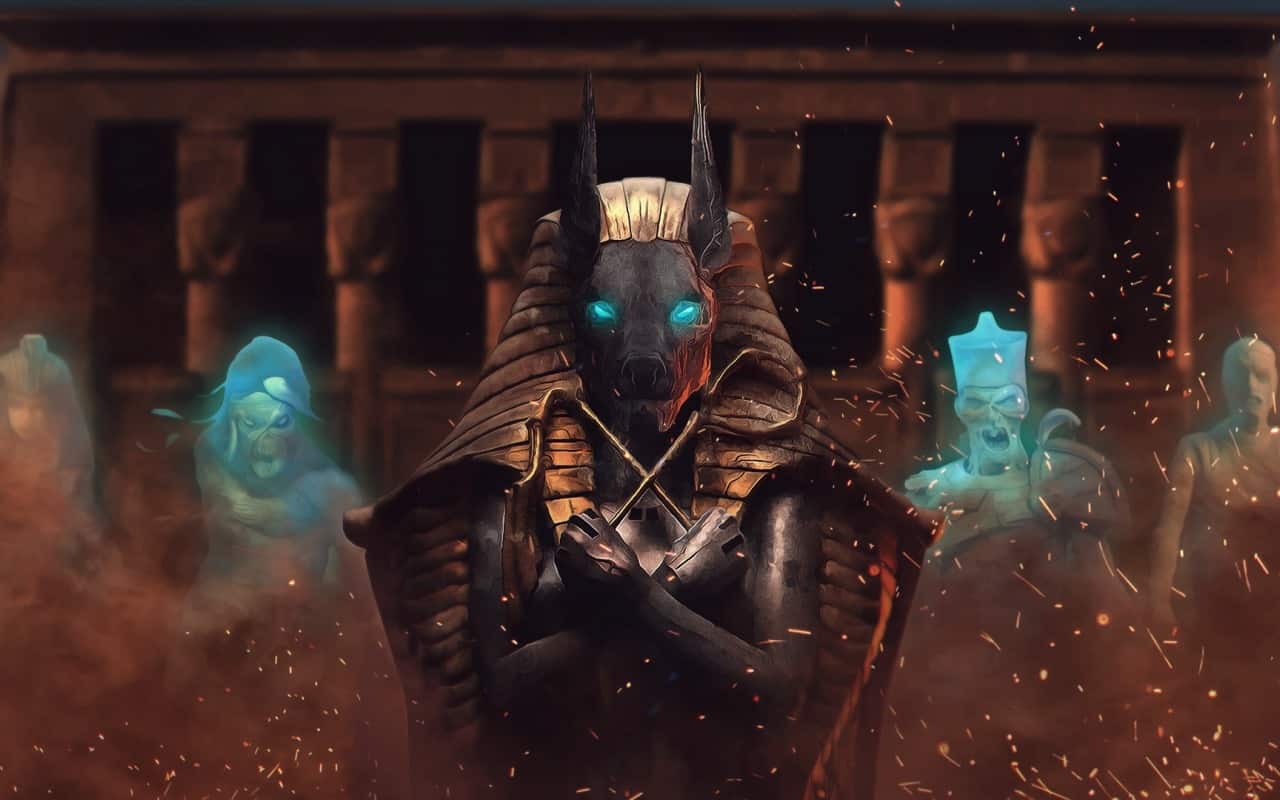
Anubis
Gergely Greczi2026-09-04T11:16:15+02:00In Ancient Egypt, the line between the natural world and the divine was remarkably thin. Many animals were considered deeply sacred, walking the earth as living symbols of the gods. As a result, most Egyptian deities were depicted with animal heads—most notably Anubis, the iconic god of the afterlife, mummification, and lost souls.
Because of his distinct pointed ears and long snout, Anubis has long been nicknamed the “dog god” of Ancient Egypt. But what kind of canine was he really, and what exactly was his role in the shadows of the underworld?
Dog, Jackal, or Wolf? The Identity Crisis
Although Anubis’ head is undeniably canine, historians, zoologists, and Egyptologists do not entirely agree on what specific type of canine he represents. In Ancient Egyptian art, he is almost exclusively depicted with black fur. To the Egyptians, black was not a color of mourning; it was the color of the fertile soil of the Nile and represented life, regeneration, and rebirth.
But beneath the symbolic black paint, what animal inspired his creation?
-
The Domestic Dog: Some scholars claim Anubis was modeled after early domestic hunting dogs, likely the direct ancestor of modern sight-hounds like the Pharaoh Hound or the Saluki.
-
The Golden Jackal: For decades, the most popular theory was that Anubis was a jackal. The Golden Jackal, which resembles a small, slender wolf, was an incredibly common scavenger in Ancient Egypt.
-
The African Golden Wolf: Recent genetic studies have thrown a new contender into the ring. The canid commonly referred to as the Egyptian jackal is actually a species of wolf—the African Golden Wolf. Found today across North Africa from Senegal to Tanzania, these monogamous hunters frequently scavenge for food.
It is highly likely that Ancient Egyptians saw these wild canines scavenging in shallow desert graveyards and chewing on bones. To appease these creatures and protect their dead, the Egyptians may have elevated the scavenger to a divine protector, effectively turning a graveyard threat into the god of the afterlife.
The Master of Mummification
While many modern pop-culture depictions paint Anubis as the dark ruler of the Underworld, that title actually belonged to Osiris. Anubis was primarily the god of embalming and the protector of tombs.
According to Egyptian mythology, when Osiris was murdered and dismembered by his jealous brother, Set, it was Anubis who painstakingly reassembled him. Anubis invented the embalming process to preserve Osiris’ body, wrapping him in linen and placing his vital organs in sacred canopic jars. Because of this, human priests would often wear wooden Anubis masks while performing mummification rituals on deceased pharaohs and nobles.
He was also a fierce guardian of the dead. In various myths, Anubis protected Osiris’s tomb from Set, famously fighting off the murderous god with a burning iron staff.
The Ultimate Judgment: Weighing the Heart
Anubis’ final and perhaps most terrifying role was acting as the psychopomp—the guide for the souls of the dead. He would take the hands of the recently deceased and lead them from the land of the living into the perilous Underworld (the Duat).
Their ultimate destination was the Hall of Ma’at, where they would face the most critical test of their existence.
1.The Presentation:
Anubis leads the deceased soul into the Hall of Judgment to stand before Osiris and a tribunal of 42 divine judges.
2.The Scales of Justice:
The heart of the dead person—believed to be the seat of their soul, memory, and emotions—is placed on one side of a great magical scale.
3.The Feather of Truth:
On the other side of the scale, Anubis places Ma’at, a single ostrich feather that represents absolute truth, balance, and universal order.
4.The Weighing:The final verdict.
-
If the heart is heavier than the feather: It means the soul is weighed down by sin and evil. The heart is immediately devoured by Ammit, a terrifying goddess with the head of a crocodile, the torso of a lion, and the hindquarters of a hippopotamus. The soul ceases to exist forever.
-
If the heart is lighter than (or equal to) the feather: The person lived a good, just life. They are permitted to pass through and enter the Field of Reeds (Aaru)—the Egyptian paradise.
From a scavenging wolf roaming the desert edges to the ultimate judge of human morality, Anubis remains one of the most fascinating and enduring figures of the ancient world.