History of the Yorkshire Terrier
The Yorkshire Terrier: A Tiny Titan
The Yorkshire Terrier is small, silky, and endlessly glamorous—but don’t be fooled by the pristine topknots and designer bows. The Yorkie packs a massive amount of attitude and terrier tenacity behind that soft, toy-like appearance. You would never suspect that this pint-sized, purse-dwelling pooch is actually a top-tier predator, originally engineered for the gritty work of catching rats in the industrial mills of Northern England.
Up North: From Mills to Mansions
The Yorkie was forged in the counties of Yorkshire and Lancashire during the height of the Industrial Revolution in the mid-19th century. As Scottish workers migrated south looking for employment in the bustling textile mills and coal mines, they brought their tough working dogs with them.
The breed we know today is a melting pot of several tough terrier types. Their main ancestors are thought to be the now-extinct Clydesdale Terrier (also called the Paisley Terrier), the Skye Terrier, the Waterside Terrier, and the English Black and Tan Toy Terrier. It is also highly suspected that a dash of Maltese was thrown into the mix to bring their size down and enhance their long, flowing coats.
From this rugged working-class lineage emerged a silky little dog with a striking grey and tan coat. Workers originally bred the Yorkshire Terrier to squeeze into the tight, dangerous spaces of the cloth mills to hunt disease-carrying vermin. However, their undeniable beauty soon caught the eye of Victorian high society, and the Yorkie quickly transitioned from a gritty rat-catcher to a pampered lapdog.
Huddersfield Ben: The Founding Father
If you own a Yorkshire Terrier today, you can likely trace its lineage back to a single, legendary dog. Born in 1865, Huddersfield Ben is universally recognized as the foundation sire of the modern breed.
Owned by the Foster family of Bradford, West Yorkshire, Ben was a true dual-purpose champion. Not only was he a fierce competitor in rat-baiting contests, but he was also a wildly successful show dog, winning over 70 prizes in his short lifetime. Though he was a bit larger than today’s standard (weighing around 11 pounds), he consistently sired tiny puppies that weighed under 7 pounds, effectively setting the permanent size standard for the breed.
In 1874, the Yorkshire Terrier was officially registered with the British Kennel Club, and the Yorkie was introduced to the Americas shortly after, competing in dog shows as early as 1878.
Appearance and Grooming
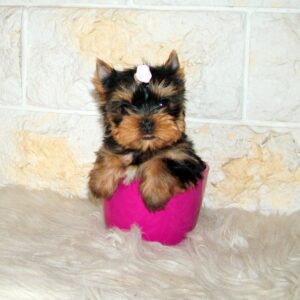
Yorkies are famously tiny, fine-boned dogs, standing a maximum of 9 inches (22.86 cm) at the shoulder. However, size can vary wildly even within a single litter, ranging from chunkier, sturdy pups to highly fragile “teacup” dogs. (Note: “Teacup” is not an official breed standard, but rather a marketing term for exceptionally small dogs, which unfortunately often suffer from severe health issues.)
One of the most recognizable features of the Yorkie is its stunning, bicolored coat. While puppies are born black and tan, their coat gradually clears to a striking steel-blue and gold as they mature.