Hachiko

The True Story of Japan’s Most Faithful Dog
Many people have shed a tear watching the heartwarming film Hachi: A Dog’s Tale, the deeply touching movie about a dog who loyally waited at a train station for his master every single day. However, you might not be as familiar with the remarkable true story of the real-life Hachiko that inspired the cinematic legend.
The real Hachi—affectionately known as Hachiko—was a beautiful Akita who lived in Japan in the early 1920s. He was the cherished companion of Professor Hidesaburo Ueno, a dedicated scholar working in the agricultural department at the prestigious University of Tokyo.
The two shared a profound, unbreakable bond, which was most beautifully displayed in their daily routine. Every morning, Hachiko would proudly walk side-by-side with his master through the city streets to Shibuya train station, watching to see the professor safely off to work. But Hachiko’s devotion didn’t stop there. Like clockwork, the faithful Akita would return to the bustling station every single afternoon, waiting patiently among the crowds to joyfully greet the professor the moment he stepped off his returning train.
A Heartbreaking Vigil Begins
This beautiful, idyllic routine continued flawlessly until Hachiko was just two years old. On the morning of May 21, 1925, Hachiko walked alongside his master to the station, watching him board the train just as they had done a hundred times before. When the afternoon arrived, the faithful Akita trotted back to the exit of Shibuya Station, taking his usual spot to wait for his beloved professor… and waited… and waited.
Tragically, Hachiko was waiting in vain. Professor Ueno would never return; he had suffered a sudden and fatal cerebral hemorrhage while at work. Following the professor’s untimely passing, his grieving relatives took Hachiko in, doing their best to provide the dog with a loving and comfortable new home. However, a new roof and the passage of time could not erase the Akita’s unwavering devotion. Every single day for the next nine years—regardless of rain, freezing snow, or the scorching summer sun—loyal Hachiko made the solitary trek back to Shibuya Station to wait for the train that would never bring his master home.
A Nation Touched by Loyalty
Initially, some commuters brushed past the solitary dog, but his heartbreaking daily vigil soon captured the hearts of station workers and regular travelers, who began bringing him food and water to sustain him. Before long, Hachiko’s story caught the attention of local and national newspapers, catapulting the humble dog to fame. People across Japan were deeply moved by his pure, unyielding loyalty. Teachers and parents began using Hachiko’s story as a shining example to teach children the profound values of familial fidelity, dedication, and steadfast love, effectively turning the Akita into a beloved national symbol of devotion.
A Legacy Cast in Bronze
In March 1935, after nearly a decade of waiting, Hachiko’s long vigil finally came to an end when he passed away on the streets of Shibuya. In a beautiful gesture of closure and reunion, his cremated remains were interred right next to the grave of his beloved master, Professor Ueno, in Tokyo’s Aoyama Cemetery. After ten long years, they were finally together again.
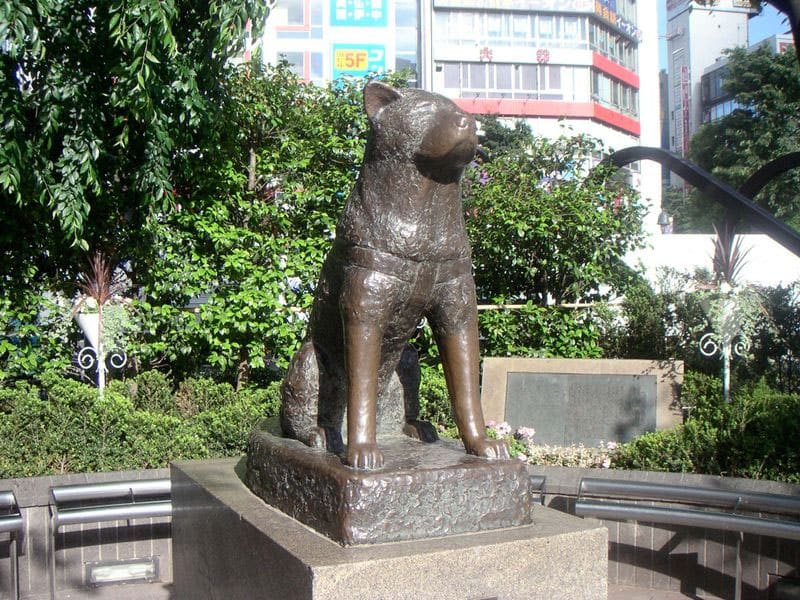
Today, Hachiko’s unbreakable spirit is immortalized in numerous ways, most notably through the iconic bronze statue that stands proudly outside Shibuya Station. The original monument was erected in 1934—with a senior Hachiko himself attending the grand unveiling. Although that first statue was tragically melted down for scrap metal during the resource shortages of the Second World War, a beautiful replacement was commissioned and installed in 1948. The exact spot where the faithful dog once sat is now marked with bronze paw prints and a respectful Japanese inscription. To this day, Hachiko is formally honored every year on April 8th, when hundreds of animal lovers gather at Shibuya Station for a solemn, touching remembrance ceremony.